



优德官网 in the AIR

Overview
Date
Jun 21, 2022
09:00 - 10:35
Venue

运动行

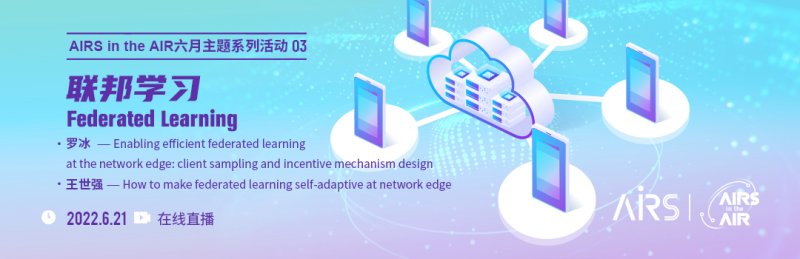
优德官网 in the AIR | Federated Learning (Session 3)

首页- 优德官网集团(中国)有限公司

Today, most areas of artificial intelligence (AI) apply machine learning to solve problems. While data is the foundation of machine learning. Data consolidation is nearly impossible or costly in most industries because of competition, privacy, and other issues. Data privacy and security are also topics of particular concern to people facing the rapid development of AI.

Federated learning enables efficient data use and machine learning modeling while protecting user privacy and data security, which is crucial to developing secure AI.

In June 2022, the Shenzhen Institute of Artificial Intelligence and Robotics for Society (优德官网) invites leading experts and young scholars from academia and industry to share their profound knowledge and inspiring opinion on the theme of "Federated Learning".

Join the event on June 21 through this link: http://hdxu.cn/LUym7

  • 首页- 优德官网集团(中国)有限公司
    Jianwei Huang
    Vice President at 优德官网; Presidential Chair Professor at The Chinese University of Hong Kong, Shenzhen
    Executive Chair
  • 首页- 优德官网集团(中国)有限公司
    Bing Luo
    优德官网-Yale Joint Postdoc Researcher
    Co Chair
  • 首页- 优德官网集团(中国)有限公司
    Bing Luo
    优德官网-Yale Joint Postdoc Researcher
    Enabling efficient federated learning at the network edge: client sampling and incentive mechanism design

    Bing Luo is a joint Postdoctoral Researcher at 优德官网 and Yale University. He received the Ph.D. from The University of Melbourne, Australia, in 2020. His current research interests are federated learning and analytics, optimization algorithms, game theory, and embedded AI for IoT, wireless and mobile systems. He was a project manager at the Department of Networking, China Mobile, Beijing, China, from 2013 to 2016. Dr. Luo was a visiting researcher at IBM T. J. Watson Research Center, USA, Yale University, USA, Friedrich-Alexander-University, Germany, and Aalto University, Finland. He received the Kenneth Myers Memorial Scholarship 2018, the Robert Bage Memorial Scholarship in 2017, and the China Mobile Technical Innovation Award in 2015. He served as Program Committee Member in FL-ICML'21, FL-IJCAI'22, and FL-AAAI'22.

    Federated learning (FL) algorithms usually sample a fraction of clients in each round (partial participation) when the number of participants is large, and the server's communication bandwidth is limited. Recent works on the convergence analysis of FL have focused on unbiased client sampling, e.g., uniformly at random, which suffers from slow wall-clock time for convergence due to high degrees of system and statistical heterogeneity. In this talk, I will first talk about how to design an efficient biased client sampling that tackles both system and statistical heterogeneity to minimize the wall-clock training time. Then, I will talk about how to design an efficient incentive mechanism and a fair payment strategy to incentivize independent clients' participation when they have different preferences for the FL model, local cost, and data quality. Experimental results based on a hardware prototype with resource-constrained IoT devices will be highlighted.

  • 首页- 优德官网集团(中国)有限公司
    Shiqiang Wang
    Research Staff Member at IBM T. J. Watson Research Center
    How to make federated learning self-adaptive at network edge

    Shiqiang Wang is a Research Staff Member at IBM T. J. Watson Research Center, NY, USA. He received his Ph.D. from Imperial College London, United Kingdom, in 2015. His current research focuses on the intersection of distributed computing, machine learning, networking, and optimization, with a broad range of applications including data analytics, edge-based artificial intelligence (Edge AI), Internet of Things (IoT), and future wireless systems. He has made foundational contributions to edge computing and federated learning that generated both academic and industrial impact. He received the IEEE Communications Society (ComSoc) Leonard G. Abraham Prize in 2021, IEEE ComSoc Best Young Professional Award in Industry in 2021, IBM Outstanding Technical Achievement Awards (OTAA) in 2019, 2021, and 2022, and multiple Invention Achievement Awards from IBM since 2016.

    Federated learning (FL) is an emerging technique for model training from decentralized data. Compared to learning from data in a central storage, FL has benefits of privacy preservation and communication bandwidth reduction. A challenge in FL is that data and model characteristics can vary largely across different tasks, and an FL task with improper configuration could waste a lot of computation/communication resources and may cause the trained model to diverge from the optimal result. In this talk, I will present adaptive FL methods that learns near-optimal configurations (e.g., synchronization interval, compressed model size) over time during the FL process, to reach the best model accuracy with the smallest amount of training time. These adaptive FL algorithms are derived from convergence analysis, online learning, and related analytical techniques. The performance of these algorithms is evaluated both theoretically and empirically. Some open problems will be also outlined.

Time Session Speaker&Topic

09:00-09:45

Keynote Speech

Bing Luo, 优德官网
Topic: Enabling efficient federated learning at the network edge: client sampling and incentive mechanism design

09:50-10:35

Keynote Speech

Shiqiang Wang,,,,,,IBM
Topic: How to make federated learning self-adaptive at network edge

Video Archive