优德官网 in the AIR

概述
日期
2023年09月01日
14:00 - 15:00
所在

优德官网 in the AIR | 用于生物医学的自力可拉伸装备平台

首页- 优德官网集团(中国)有限公司

可拉伸的电子装备在基础生物医学研究、疾病诊断确认、康健老龄化、人机界面和智能物联网等领域都具有重大的应用潜力。 。。。。下一代可拉伸电子装备的现实应用取决于可拉伸一连电源与高迅速度皮肤传感器和无线传输?????? ?榈募。 。。。。本期优德官网 in the AIR约请程寰宇副教授先容自力可拉伸装备平台背后的挑战,,,,,,,,设计战略和新颖的制造工艺。 。。。。

程寰宇是宾夕法尼亚州立大学副教授,,,,,,,,他合著揭晓140多篇论文,,,,,,,,总引用次数达18000次,,,,,,,,曾获洪堡资深研究职员奖学金、MIT手艺谈论35岁以下立异者(TR35 China)、福布斯30 Under 30等声誉。 。。。。他的团队主要研究自力可伸缩装备平台的设计、制造和应用。 。。。。

通过Bilibili(http://live.bilibili.com/22587709)加入。 。。。。

呼吸新鲜空气,,,,,,,,相识前沿科技!优德官网 in the AIR 为 优德官网 重磅推出的系列运动,,,,,,,,与您一起探索人工智能与机械人领域的前沿手艺、工业应用、生长趋势。 。。。。

  • 首页- 优德官网集团(中国)有限公司
    朱建
    优德官网 项目认真人、香港中文大学(深圳)副教授
    执行主席
  • 首页- 优德官网集团(中国)有限公司
    程寰宇
    宾夕法尼亚州立大学副教授
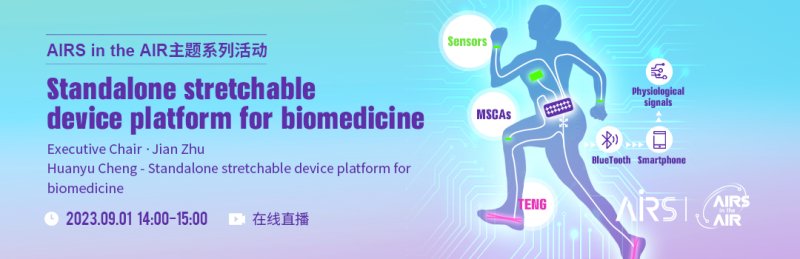
    Standalone stretchable device platform for biomedicine

    Prof. Huanyu "Larry" Cheng is the James L. Henderson, Jr.Memorial Associate Professor of Engineering Science and Mechanics at Penn State University. His research group focuses on the design, fabrication, and application of the standalone stretchable device platform. Larry has co-authored more than 140 publications with total citations >18,000 according to Google Scholar. His work has been recognized through the reception of numerous awards, including the 2023 Emerging Investigator for Nanoscale, Humboldt Research Fellowship for Experienced Researchers, 2022 Minerals, Metals & Materials Society (TMS)Functional Materials Division (FMD) Young Leaders Professional Development Award, 2021 NIH Trailblazer Award, MIT Technology Review Innovators Under 35 (TR35 China) in 2021, 2021 Scialog Fellow in Advancing BioImaging, 2021 Frontiers of Materials Award from TMS, Forbes 30 Under 30 in 2017, among others. He also serves as the associate editor for 7 journals and reviewer for > 250 journals.

    Conventional electronics today form on the planar surfaces of brittle wafer substrates and are not compatible with 3D deformable surfaces. As a result, stretchable electronic devices have been developed for continuous health monitoring. Practical applications of the next-generation stretchable electronics hinge on the integration of stretchable sustained power supplies with highly sensitive on-skin sensors and wireless transmission modules. This talk presents the challenges, design strategies, and novel fabrication processes behind a potential standalone stretchable device platform that (a) integrates with 3D curvilinear dynamically changing surfaces, and (b) dissolves completely after its effective operation. The resulting device platform creates application opportunities in fundamental biomedical research, disease diagnostic confirmation, healthy aging, human-machine interface, and smart Internet of Things.