马尔科夫博弈组成了多智能体强化学习和智能体顺序交互的研究基础!�。。�。�。。�,,,�,�,,其最优解被称为完善平衡(Markov perfect equilibrium,�,,,�,�,,MPE)。。�。。�。�。。已有研究批注,�,,,�,�,,在无界马尔科夫博弈中求解 MPE 至少是 PPAD 难题的。。�。。�。�。。因此,�,,,�,�,,邓小铁教授及其相助者提出了近似马尔科夫完善平衡作为无界多人广义和马尔科夫博弈盘算问题的解看法,�,,,�,�,,并证实晰该解看法既保存了马尔科夫完善性子又具有 PPAD-Complete 重漂后。。�。。�。�。。该解的看法为多智能体学习算法由静态双人博弈乐成扩展到动态多人马尔科夫博弈涤讪了盘算重漂后理论基础!�。。�。�。。�,,,�,�,,为漫衍式人工智能、多智能系一切研究开发了新的路径与思绪。。�。。�。�。。
第八期 优德官网-TNSE 团结优异讲座系列运动,�,,,�,�,,我们有幸约请到北京大学的邓小铁教授先容马尔科夫博弈的近似完善平衡,�,,,�,�,,并分享他在这个领域内的相关研究效果与有趣发明。。�。。�。�。。
优德官网-TNSE Joint Distinguished Seminar Series is co-sponsored by IEEE Transactions on Network Science and Engineering (TNSE) and Shenzhen Institute of Artificial Intelligence and Robotics for Society (优德官网), with joint support from The Chinese University of Hong Kong, Shenzhen, Network Communication and Economics Laboratory (NCEL), and IEEE. This series aims to bring together top international experts and scholars in the field of network science and engineering to share cutting-edge scientific and technological achievements.
Join the seminar on April 28 through Bilibili (http://live.bilibili.com/22587709).
-
Jianwei Huang
Vice President, 优德官网; Presidential Chair Professor, CUHK-Shenzhen; Editor-in-Chief, IEEE TNSE; IEEE Fellow; AAIA Fellow
Executive Chair
-
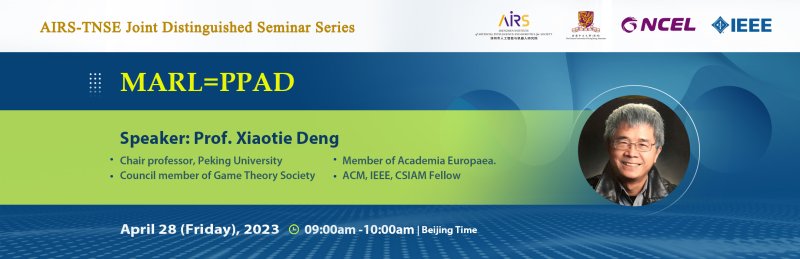
邓小铁
Chair professor, Peking University; Council member of Game Theory Society; Member of Academia Europaea; ACM, IEEE, CSIAM Fellow
MARL=PPAD
邓小铁教授,�,,,�,�,,于1982年在清华大学获得学士学位,�,,,�,�,,于1984年在中国科学院获得硕士学位,�,,,�,�,,于1989年在斯坦福大学获得博士学位。。�。。�。�。。2017年12月他入职北京大学,�,,,�,�,,任盘算机学院前沿盘算研究中心讲席教授。。�。。�。�。。他曾任教于上海交通大学、利物浦大学、香港都会大学和约克大学。。�。。�。�。。在此之前,�,,,�,�,,他照旧西蒙菲莎大学的 NSERC 国际研究员。。�。。�。�。。邓小铁教授的主要科研偏向为算法博弈论、区块链、互联网经济、在线算法及并行盘算。。�。。�。�。。2008年,�,,,�,�,,他因在算法博弈论领域的孝顺中选 ACM Fellow�;�;�;;�;�;�;;2019年,�,,,�,�,,因在不完全信息盘算和交互情形盘算领域的孝顺中选 IEEE fellow�;�;�;;�;�;�;;2020年中选欧洲科学院外籍院士�;�;�;;�;�;�;;2021年中选中国工业与应用数学学会会士(CSIAM Fellow)�;�;�;;�;�;�;;2021年被任命为博弈论学会(GTS)理事�;�;�;;�;�;�;;2021年被聘为中国运筹学会博弈论分会声誉理事�;�;�;;�;�;�;;2021年获得 CCF 人工智能学会多智能体与多智能系一切研究成绩奖�;�;�;;�;�;�;;2022年获得 ACM 盘算经济学的“时间磨练奖”(Test of Time Award)。。�。。�。�。。
Similar to the role of Markov decision processes in reinforcement learning, Markov games (also known as stochastic games) form the basis for the study of multi-agent reinforcement learning and sequence-agent interaction. We introduce an approximate Markov perfect equilibrium as a computational problem for solving finite-state stochastic games under infinite time discounting, and prove its PPAD completeness. This solution concept preserves the Markovian-perfect property, opening the possibility to extend successful multi-agent reinforcement learning algorithms to multi-agent dynamic games, thus extending the range of PPAD complete classes.